


The marketplace model is a business structure that connects multiple sellers with buyers on a shared digital platform. Unlike traditional retailers or service providers that sell directly to customers, marketplaces don’t own inventory or provide services. Instead, they facilitate interactions between third parties and take a commission or fee from transactions.
Understanding marketplace business models matters whether you’re building a platform from scratch or choosing where to sell your products. In this guide, I’ll cover the major marketplace models, their various types, success factors, challenges, and practical insights to help you build your own marketplace in 2026.
How Does a Marketplace Differ From Traditional Business Models?
Traditional business models follow a linear supply chain:
- Manufacturers create products
- Distributors move them to retailers
- Retailers sell to consumers
Each entity in this chain purchases inventory, manages logistics, and handles customer service for its specific segment. Economists and platform strategists call this a pipeline business model, distinct from the platform approach that marketplaces use.
Marketplaces break this linear approach in several key ways:
- No inventory ownership: Marketplaces don’t purchase, hold, or manage inventory. This eliminates overhead costs over time.
- Multi-sided platform: They connect multiple parties (typically buyers and sellers) rather than operating as a single entity selling to customers. Economists call this a two-sided market or multi-sided platform, a structure where the platform creates value by facilitating interactions between distinct user groups.
- Network effects: A marketplace’s value increases as more users join, creating a powerful buyer-seller community.
- Revenue model: Instead of profiting from product markups, marketplaces typically earn through transaction fees, subscriptions, or listing fees.
A good example is Airbnb versus a hotel chain. The hotel chain builds or buys properties, maintains them, staffs them, and markets directly to customers. Airbnb owns no properties but connects property owners with travelers while handling the transaction platform, verification systems, and dispute resolution. That’s the platform business model in action: asset-light, scalable, and built on network density rather than owned inventory.
If you’re planning to launch your own marketplace, understanding how to build a brand from scratch is essential to stand out and attract both buyers and sellers.
Benefits of the Online Marketplace Business Model
With the core mechanics out of the way, it’s worth looking at why this model has become so popular with founders and sellers alike. Here’s what a marketplace actually gives you that a traditional business doesn’t.
1. It increases visibility across borders:
Online marketplaces remove geographical limitations, giving businesses access to a worldwide audience. Expanding your potential customer base makes increasing sales and achieving significant revenue growth more achievable. For example, global mobile eCommerce marketplace sales accounted for 60% of all online transactions in 2023, highlighting their importance in the digital economy.
2. Lower marketing costs:
Marketplaces handle much of the marketing, which reduces your business’s marketing costs. Sellers can attract customers by using their promotion tools, high website traffic, and established reputation.
3. It lowers operational costs:
Unlike physical storefronts, marketplaces eliminate the need for expensive retail locations and large teams. This asset-light model keeps operational costs low, lets you focus on expanding your product range, and helps you grow sales without proportional overhead increases.
4. Makes it easy to connect buyers and sellers:
Marketplaces simplify product comparisons for customers, letting them evaluate features, pricing, and reviews before purchasing. For sellers, they make it straightforward to add products, manage prices, and reach the right audience.
5. Offers scalability and growth opportunities:
By letting you list more products, reach international markets, and use localized tools, marketplaces support growth with minimal barriers. Network effects drive this scalability: as more buyers and sellers join, the platform’s liquidity increases, which in turn attracts even more participants.
Disadvantages of the Marketplace Business Model
Of course, none of this comes for free. Running a marketplace introduces its own set of structural challenges that a traditional, single-sided business never has to deal with. Here’s where things get harder.
1. Balancing supply and demand:
Maintaining equilibrium between buyers and sellers is vital to marketplace success. An imbalance often leads to dissatisfied users or reduced activity.
2. Building trust among users:
Trust and safety are foundational challenges for any marketplace. Users hesitate when they have concerns about fraud or product quality. Platforms address this through identity verification, review systems, and escrow payments, mechanisms that make transactions safer and reduce the risk of disputes.
3. Ensuring platform security:
Cybersecurity issues like data breaches or fraudulent transactions can damage your marketplace’s reputation. Strengthen user data protection with tools like encryption and two-factor authentication.
4. The cold start problem:
New marketplaces face a chicken-and-egg dilemma: sellers won’t join without buyers, and buyers won’t come without sellers. This is one of the primary reasons many marketplace startups struggle in their early stages. Strategies to overcome it include seeding one side of the market (Airbnb manually recruited early hosts in New York City), sequencing geographic launches, or launching as a SaaS tool first to build supply before opening demand.
Different Types of Marketplace Business Models
Marketplace business models can be classified along multiple dimensions: by who transacts (B2B, B2C, C2C), by what is exchanged (products, services, rentals), and by how broadly they serve the market (horizontal vs. vertical). Here are the common types of marketplace business models.
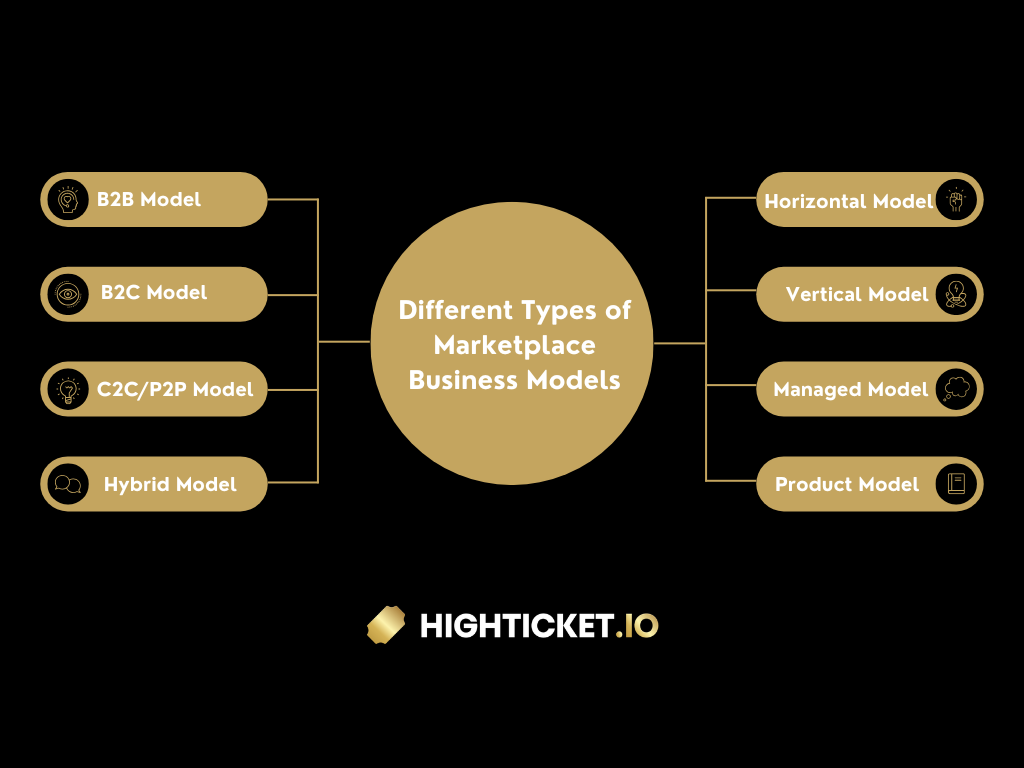
i. Business-to-Business (B2B) Marketplace Model
B2B marketplaces connect businesses that sell products or services with other companies that need them. Examples include Alibaba and Flexport.
Pros:
- Higher average order values
- Longer customer relationships
- More predictable purchasing patterns
- Lower customer acquisition costs relative to transaction size.
Cons:
- Complex requirements and expectations
- Longer sales cycles’
- Need for specialized industry knowledge
- Higher standards for reliability and quality
ii. Business-to-Consumer (B2C) Marketplace Model
A B2C marketplace connects businesses directly with individual consumers. This model delivers an end-to-end shopping experience, including browsing, purchasing, and delivery. Amazon is the dominant example in this category.
Pros:
- Higher average order values
- More consistent inventory and service availability
- Professional seller standards and customer service.
Cons:
- Competing with large established retailers
- Maintaining quality control across numerous businesses
- Ensuring consistent customer experiences.
iii. Consumer-to-Consumer or Peer-to-Peer Marketplace Model (C2C/P2P)
A C2C or P2P model enables individuals to act as both sellers and buyers. Examples include Airbnb, eBay, and Etsy.
Pros:
- Lower barriers to entry for sellers
- Creates unique inventory unavailable elsewhere
- It can foster community among users with shared interests
- Enables more price negotiation.
Cons:
- Inconsistent seller quality and reliability
- Trust can be a limiting factor
- Higher chances for disputes and misunderstandings.
iv. Hybrid Marketplaces
Hybrid marketplaces combine features of two or more models, targeting mixed audiences to maximize revenue potential. For example, Amazon operates as both a B2C retailer and a third-party seller marketplace simultaneously.
Pros:
- Multiple revenue streams
- Ability to serve diverse customer needs
- Can control quality through first-party offerings
- Often creates stronger platform lock-in.
Cons:
- More complex operations
- Potential conflicts of interest
- Requires significantly more resources
- More difficult to communicate a clear value proposition.
v. Horizontal vs. Vertical Marketplaces
A horizontal marketplace serves multiple product categories across a broad audience. Amazon and eBay are the canonical examples. A vertical marketplace focuses on a single industry or niche, such as Houzz (home renovation), Reverb (musical instruments), or Faire (wholesale for independent retailers).
Vertical marketplaces typically win on category depth, curated supply, and higher buyer intent, but face a smaller total addressable market. The downside of vertical is that horizontal means breadth, lower margins, and winner-take-most dynamics. Also, vertical means depth, higher margins, and a defensible niche.
vi. Product, Service, and Rental Marketplaces
The type of transaction also defines the model. Product marketplaces facilitate the sale of physical or digital goods. Service marketplaces connect buyers with providers of time-based work. For example, platforms like TaskRabbit and Thumbtack operate this way. Rental and access marketplaces enable temporary use of assets without ownership transfer, as Airbnb and Turo do with homes and vehicles.
vii. Managed vs. Unmanaged Marketplaces
An unmanaged marketplace lets supply and demand interact with minimal platform intervention. Early eBay and Craigslist are the clearest examples. A managed marketplace standardizes the supply side by vetting providers, setting prices, or guaranteeing quality, in exchange for higher take rates and a better buyer experience.
Since 2015, the trend has shifted toward managed models to solve the trust and quality-consistency problems that unmanaged platforms struggle with.
Still debating between marketplace models and fulfillment methods? Explore the key differences between Amazon FBA and dropshipping to understand what best fits your goals.
Types of Revenue Model-Based Online Marketplace Models
Each revenue model aligns with different marketplace dynamics. The right choice depends on your transaction frequency, average order value, and how scarce supply is relative to demand.
1. Commission Model
The commission model charges a percentage or fixed fee for each transaction conducted on the platform. It’s the most common choice because it scales directly with gross merchandise volume (GMV).
Typical commission rates, also called take rates, range from 5% to 30% depending on category. As of 2026, Airbnb charges most hosts a single 15.5% host-only service fee (16% in Brazil and Mexico), having phased out its older split-fee structure (roughly 3% from hosts plus a separate 14-16.5% guest fee) throughout late 2025 and 2026. Etsy charges a 6.5% transaction fee, unchanged since 2022. Freelance platforms charge sellers on a sliding scale based on lifetime billings with a client.
Commission works best for high-frequency, variable-value transactions where both sides benefit from the platform’s trust infrastructure. Platforms connecting buyers and sellers of goods or services, such as eCommerce and gig economy marketplaces, most commonly adopt this model.
2. Subscription/Membership Model
In the subscription model, customers pay a recurring fee to access the platform’s services, features, or premium benefits. Amazon Prime charges buyers $139 per year in the US while also charging sellers through fulfillment fees, a dual-sided subscription dynamic that locks in both sides of the market.
This model suits marketplaces offering recurring value, such as seller tools, premium content, or guaranteed delivery benefits.
3. The Freemium Model
The freemium model offers basic services for free and charges for access to premium features or tools. LinkedIn’s talent marketplace works this way: it’s free for basic job seekers and recruiters, with premium tiers unlocking advanced search and outreach capabilities at significantly higher annual costs.
Freemium works best for platforms with high user volume where a small percentage of power users will pay for advanced functionality.
4. Listing Fee Model
The listing fee model charges sellers a fee for each product or service they list on the marketplace. This works best when supply is scarce, and sellers are motivated to pay for placement access, common in real estate or job platforms.
5. Featured Listings Ads Model
The featured listings ads model charges sellers to promote their products or services to gain higher visibility on the platform. This suits marketplaces that rely on high competition among sellers, such as e-commerce platforms, job boards, and real estate websites.
6. Lead Fee Model
The lead fee model charges sellers when they receive leads or valuable contacts from the marketplace. Service-oriented platforms that connect professionals with potential customers, such as freelance or local service marketplaces, commonly use this.
7. Payment Processing and Fintech Fees
Some mature marketplaces monetize the payment layer itself. Marketplace-embedded payment infrastructure allows platforms to earn 0.5% to 2% on payment processing in addition to commissions. This model is increasingly common as marketplaces expand into financial services including lending, insurance, and buy now pay later (BNPL) products. This works best for high-volume marketplaces with enough GMV to make fractional basis points meaningful at scale.
How to Choose an Online Business Model
With the types, revenue models, and tradeoffs on the table, the real question is which one fits what you’re building. Here’s a practical, step-by-step way to work through that decision.
Step 1: Define Your Business Requirements and Goals
The first step in choosing the right marketplace is defining your business goals and requirements. This will help you identify the core functions your chosen marketplace should have. Consider whether your goal is to generate recurring revenue, scale quickly, or dominate a niche.
Step 2: Consider the Product Type and Target Market
Each online marketplace has unique features catering to specific audiences and product types. For instance, if you sell handmade or vintage items, a C2C platform like Etsy is a strong choice. If you’re selling B2B products, platforms with hybrid business models that serve both business and consumer buyers are often a better fit.
Step 3: Assess the Different Platforms and Choose the One That Fits Your Needs
Compare platforms based on pricing structures, policies, and features:
- Pricing and Fees: Review the full fee structure carefully before committing.
- Policies and Seller Terms: Review return policies, seller protection, and dispute resolution processes.
- Shipping and Fulfillment Support: Check whether the platform integrates with shipping carriers for seamless order processing.
- Marketing and Visibility: Factor the cost of paid visibility into your margin calculations from day one.
Step 4: Assess Scalability
Look for scalability features such as:
- Flexible inventory management to sync inventory across multiple sales channels
- Automated fulfillment through third-party logistics (3PL) integration
- Multi-channel selling support for social shops, Google Shopping, and other marketplaces
- Customization and API support for future automation and CRM tools
- Customer service scalability through built-in automation or support integrations
Step 5: Assess the Competition and Marketing Opportunities
Research the level of competition and marketing options available before settling on a marketplace. If a marketplace is oversaturated, consider a vertical or niche platform with less competition but higher buyer intent.
Step 6: Evaluate the Platform’s Take Rate and Fee Structure
Calculate your fully-loaded cost of selling on each platform: commission plus listing fees plus payment processing plus advertising spend. Build a simple unit economics model before committing. Know your margin at every fee layer, not just the headline take rate.
Bottom Line
Choosing the right marketplace business model comes down to matching your product type, target customer, and growth stage to the platform’s strengths. Start with one model, validate your unit economics, and expand to hybrid or multi-channel approaches once you have proof of concept.
If you’re weighing which of the types of marketplace business models fits your own venture, hearing from people who’ve actually built one helps. Browse our success interviews for real founder stories, or check out our program if you want structured, expert-led guidance on building a high-ticket e-commerce business from the ground up.