

You're getting clicks. Maybe you're even getting leads. But somewhere between "stranger on the internet" and "paying customer," people are falling off, and you're not sure why. That's what a broken sales funnel looks like from the inside.
I've been there. Early on, I was writing Twitter threads, making YouTube videos, doing everything right on the content side, and I felt like a hamster on a wheel. If I stopped making content, sales would stop. That's a job, not a funnel. The moment I understood what a proper funnel actually does, everything changed.
This guide breaks down every stage of the sales funnel, how to build one from scratch, how to find and fix leaks, and what to track to make data-driven decisions.
What Is a Sales Funnel and How Does It Work for Online Businesses
A sales funnel is the path a person takes from first hearing about your business to actually buying from you. It's called a funnel because, like a real funnel, you start with a wide mouth at the top (lots of potential buyers) and narrow down toward the bottom (the people who actually convert).
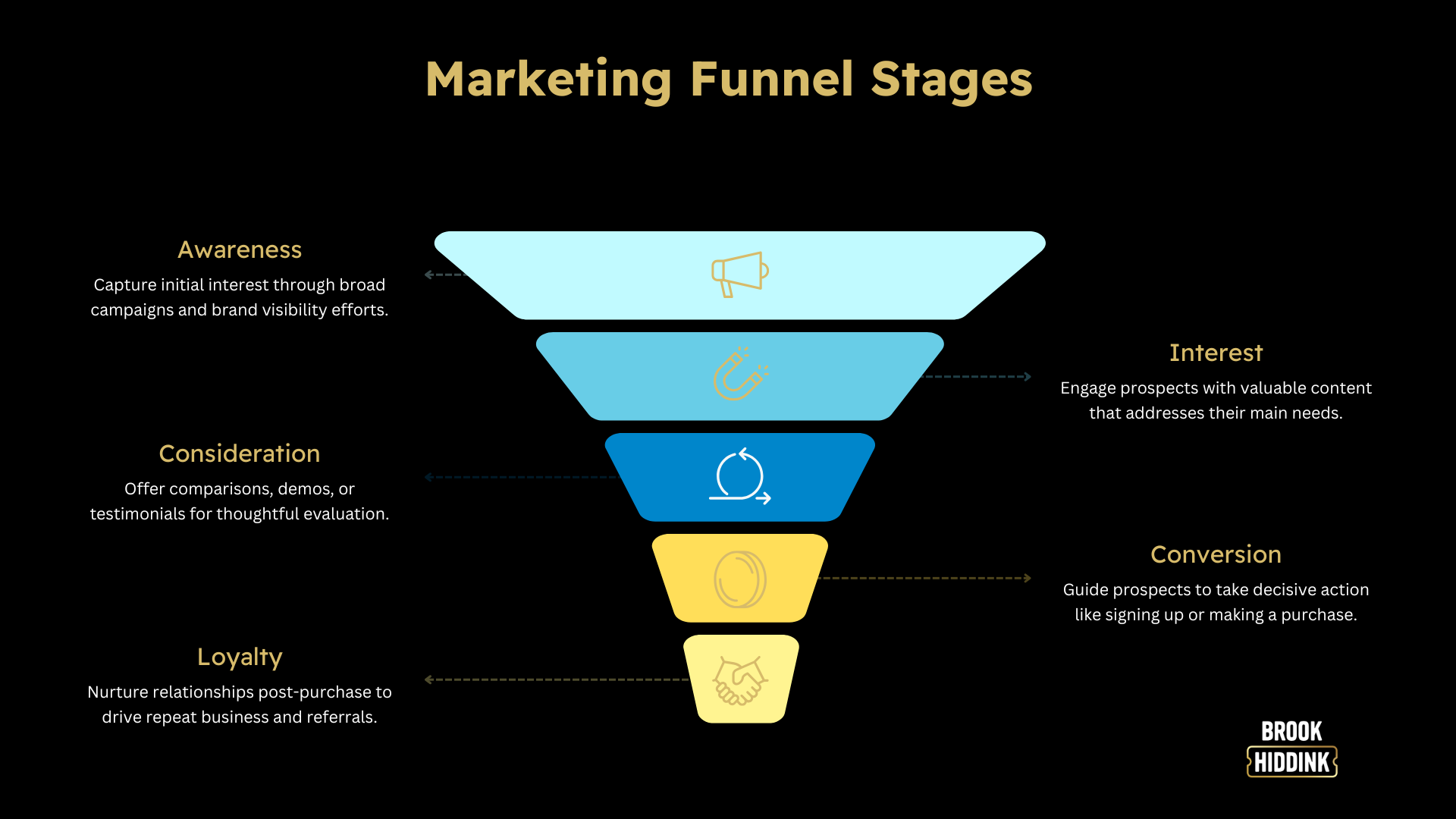
The narrowing is completely normal. Not everyone who sees your ad is ready to buy. The goal is to convert the right people at the right time, and to do so predictably.
Without a funnel, your revenue is basically random. You're relying on timing, luck, and whoever happens to be in the right headspace when they stumble onto your page. A proper funnel takes that randomness out of the equation and replaces it with a system that works whether you're online or not.
How the Sales Funnel Works Step-by-Step
At the highest level, a sales funnel moves someone through four broad phases:
- They become aware of you
- They get interested
- They evaluate your offer
- They decide to buy (or not)
In practice, most online businesses use a six-stage model that provides much more precision about where people are in the process and what they need to hear next.
Each stage has a different goal, content, and success metrics. You can't treat a cold lead who just found your Instagram the same way you treat someone who's been on your email list for three weeks and watched your VSL. Those two people need completely different conversations.
The funnel gives you a map for having the right conversation at the right time.
Sales Funnel vs Sales Pipeline
A sales funnel describes the buyer's journey: what your prospect thinks, feels, and does at each stage. It's customer-centric. A sales pipeline describes the steps your sales team or system takes to move a lead toward a close. It's operations-centric.
Both matter, but they serve different purposes. When you're thinking about messaging and content, think funnel. When you're thinking about follow-ups, deal stages, and CRM management, use a pipeline. Most people build one without the other, and that's usually why leads fall through the cracks.
The Core Sales Funnel Stages Explained (6-Stage Breakdown)
Here's a breakdown of the sales funnel stage:
Stage 1 – Awareness (Top of the Funnel)
This is the top of the funnel. Someone has just discovered you exist, via a Google search, a social media post, a referral, or an ad. They don't know what you do yet. Your job at this stage is to be worth noticing.
Your content needs to signal relevance immediately. If someone searches "how to generate more leads for my coaching business" and lands on your blog, the first thing they see should make it clear they're in the right place. Good awareness content meets people where they are in their problem, not where you are with your solution.
According to HubSpot, 61% of marketers say generating traffic and leads is their biggest challenge, which means most businesses are investing in awareness without the infrastructure to capture it. That's the trap. You can have all the traffic in the world and still not build a business if the funnel isn't there to receive it.
Stage 2 – Interest (Engaging the Prospect)
Now they know you exist. Stage two is about turning that awareness into genuine curiosity. They're reading more, clicking around, maybe watching a video. They're not ready to buy, but they're open to being educated.
This is where your lead magnet comes in. A well-designed lead magnet — a checklist, a mini-course, a calculator, a template — captures their email in exchange for something useful. This exchange signals intent: someone who gives you their email address is more invested than someone who just scrolled past your content.
The lead magnet needs to be specific. "7-Day Email Sequence Template for Coaches Selling $3K+ Programs" is a strong example. The more targeted it is, the higher the opt-in rate, and the more qualified your list becomes. Businesses with the strongest top-of-funnel performance are the most specific about who they're talking to.
Stage 3 – Consideration (Middle of the Funnel)
At the consideration stage, your prospect is actively comparing options. They might be evaluating you against two competitors and asking themselves, "Is this the right solution for my situation?" Your job is to give them a clear answer: case studies, email sequences, webinars, and comparison content that builds trust and removes doubt.
This stage takes time. Research from Highspot puts the average B2B sales cycle at 60–120 days. Even in info-product and coaching markets, warm leads often need multiple touchpoints before they're ready to move.
The number one thing that moves people through this stage? Proof it worked for someone like them. For example, I added several testimonials on HighTicket's landing page to show prospects that my HighTicket Accelerator program works:
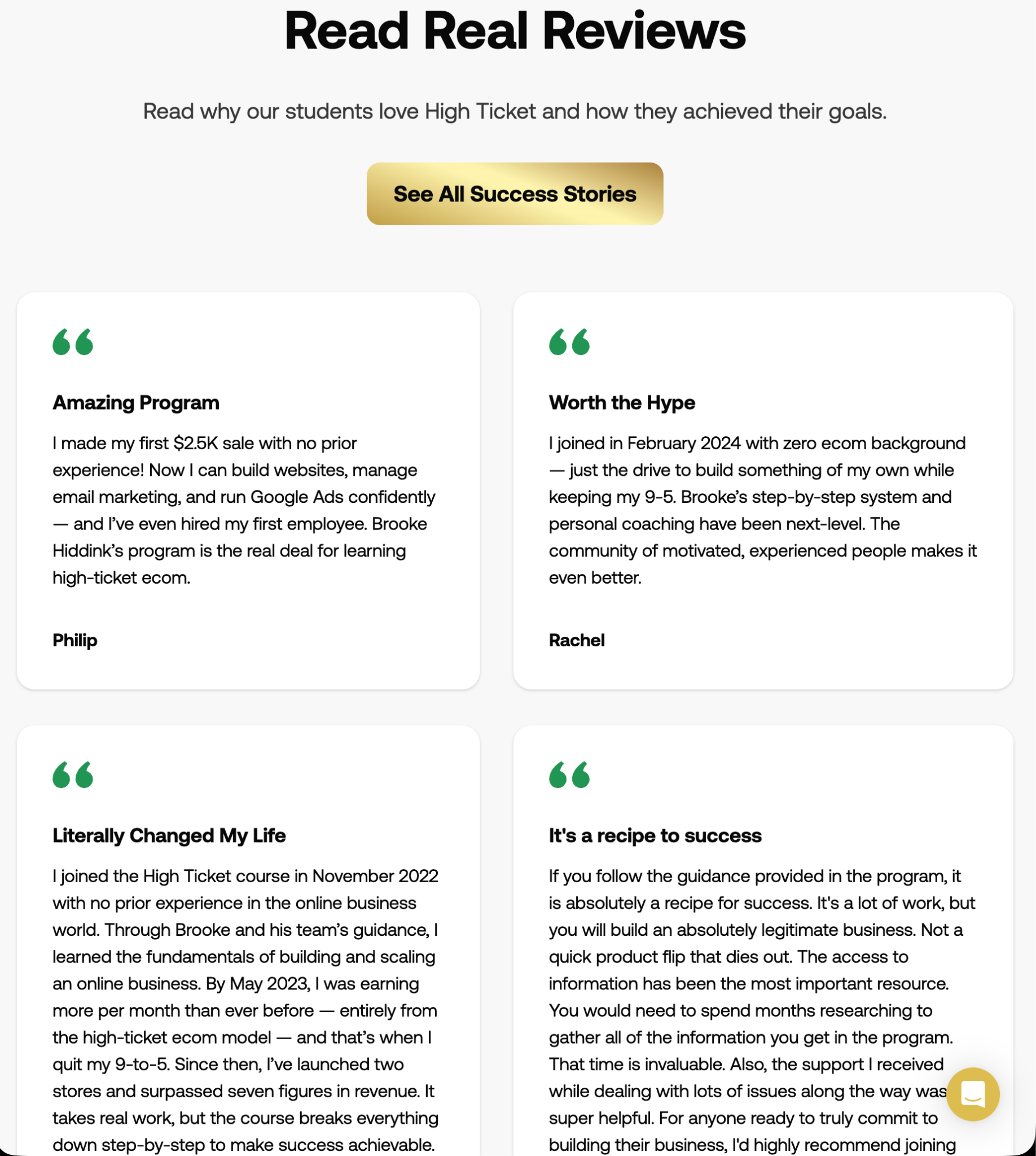
Case studies are the engine. Get results for your clients, document those results, and put them in front of fence-sitters. That's what drives conversion at this stage.
Stage 4 – Intent (Qualified Leads Ready to Buy)
Intent signals are the good stuff. This is when someone books a call, visits your pricing page multiple times, adds something to their cart, or replies to an email asking about your program. They're actively considering spending money.
At this stage, the conversation needs to shift from broad education to specifics: what your offer includes, what results similar clients have gotten, and what the onboarding process looks like. These are the questions that close deals, and they need clear answers.
Think about it from the buyer's side. The number-one thing people evaluate at this stage usually isn't price. It's whether they believe it will work for their specific situation, given what they've already tried. Your intent-stage content needs to speak directly to that.
If you're selling something high-ticket, a sales call or application process makes sense here. Intent-stage leads are your hottest prospects, and a well-run call can convert them far more effectively than any automated sequence.
Stage 5 – Evaluation (Decision-Making Stage)
The prospect is almost there. They've done their research, they like what they see, but they haven't pulled the trigger yet. Why? Usually, it's one of three things:
- Price resistance
- Lingering doubt about whether it'll work for their specific situation, or
- Uncertainty about what happens if it doesn't.
Evaluation-stage content is objection-handling content. Strong testimonials, a clear FAQ, a money-back guarantee, and direct responses to common concerns all do heavy lifting here. Video testimonials are especially effective. According to Wyzowl, two out of three people say they're more likely to purchase after watching a testimonial video that shows how a product or service helped someone like them.
How you frame your offer matters as much as the price itself. If someone's main objection is upfront commitment, consider whether your offer structure can address that directly. The objections your leads raise tell you exactly how to better frame the offer.
Urgency helps too. Artificial scarcity damages trust. An enrollment deadline or limited availability can be the nudge someone needs to stop sitting on the fence.
Stage 6 – Purchase (Bottom of the Funnel)
At this stage, the prospect eventually buys, but your job isn't done yet.
A smooth checkout experience, an immediate confirmation, and a well-designed onboarding sequence all affect whether your new customer feels good about their decision. Buyer's remorse is real, and it shows up in refund requests and poor reviews. A strong post-purchase experience prevents that.
More importantly, the results your clients get after they buy fuel the whole funnel above. Great case studies come from clients who got real outcomes. Those case studies become your best content for the consideration and evaluation stages. The bottom of the funnel feeds the middle. That loop is how the best businesses grow without constantly manufacturing new authority.
How to Build a Sales Funnel from Scratch (Step-by-Step)
Step 1 – Define Your Ideal Buyer and Offer
Before you build anything, get clear on two things: who you're selling to, and what you're selling them.
"Who you're selling to" needs to go deeper than demographics. Answer questions like:
- What specific problem are they trying to solve?
- What have they already tried?
- What's stopping them from solving it on their own?
- What objections will they have to your offer specifically?
Surveying your existing customers is one of the most underrated moves here. Once you understand your actual buyer, your messaging gets better.
Your offer also needs to be clear. Instead of randomly stating a coaching or course, be specific about the outcome the buyer walks away with, the timeframe, and the process.
Step 2 – Choose the Right Funnel Type
Not all funnels are built the same. The right structure depends on your price point, offer complexity, and the level of trust you need to build before someone buys.
For high-ticket services ($5K and above), you need a longer funnel: content, lead magnet, email nurture, VSL or webinar, application, sales call.
For mid-ticket digital products ($500–$2K), a shorter funnel works: a lead magnet, an email sequence, a sales page with strong social proof, and a clear CTA.
For lower-ticket products under $500, automated funnels with minimal human touchpoints can work well, especially if your lead magnet quality is high and your email sequence is doing its job.
Also, match the funnel to the offer. Trying to sell a $10K program through a three-email automated sequence rarely works.
Step 3 – Create Funnel Assets
Now you build the actual components: your lead magnet, landing page, email sequences, sales page or VSL, checkout page, and any video content that supports the funnel.
Every asset should have one job. Your landing page's job is to get the opt-in, not explain your entire backstory. Your email sequence's job is to build trust and educate, not hard sell in every message. Your VSL's job is to move a warm lead toward the next step.
Also, keep the copy clear and the design clean. Cluttered pages lose conversions. If someone lands on your page and can't immediately tell what you offer, who it's for, and what to do next, you've lost them.
Step 4 – Set Up Marketing Automation and AI Tools
Automation is what makes a funnel scalable. Without it, you're manually following up with every lead, which works at small volume and breaks completely at scale.
At minimum, you need an email marketing platform with behavioral triggers, a CRM to track where each prospect is in the funnel, and a calendar booking tool with automated reminders to reduce no-shows.
AI tools are table stakes at this point. The way I think about it is this: if we couldn't use AI effectively in our business, we'd need 50 more employees to achieve the same output. That is, if you're producing content, managing sequences, and personalizing follow-up at any volume. Chatbots on high-intent pages can handle the bulk of these tasks in real time.
Step 5 – Launch and Track Your Funnel
Launch before it's perfect. A live, imperfect funnel gives you data
Set up tracking from day one: UTM parameters on your ads, conversion events in your analytics, and a simple dashboard that shows you how each stage is performing. You can't fix what you can't measure, and the first version of almost every funnel has at least one major leak you won't find until real traffic is running through it.
How to Get More Conversions from Your Funnel
1. Identify Bottlenecks at Every Stage
Fixing your funnel starts with identifying where people drop off. For each stage, check how many:
- People land on the landing page
- Opt in
- Open the first email
- Click through
- Book a call
- Show up
- Many buy.
Let's examine a possible scenario:
A lead magnet is converting at 40%, but only 4% of those leads are booking a call. The funnel in this case fails midway. This could be because the email sequence isn't building enough trust to motivate action.
What to do: Rewrite it with better case studies, clearer expectations about the call, and more specificity about who the program is for.
Find the leak first. Then fix it. Don't pour more traffic into a leaky funnel.
2. Improve Conversion Rates Across the Funnel
Moving your landing page from a 20% to a 30% opt-in rate means 50% more leads from the same ad spend. Moving your email click rate from 5% to 8% means 60% more people reaching your sales page.
Headlines, CTAs, email subject lines, and the order of information on your sales page are all worth testing. Change one thing at a time, measure the impact, then move on to the next.
3. Use AI to Improve Funnel Performance
AI has made funnel analysis faster and more precise than it's ever been. Predictive lead scoring flags which prospects are most likely to convert, so you can concentrate your follow-up where it matters. AI-driven personalization (adjusting email content based on what a lead has already engaged with) beats generic sequences in head-to-head testing.
4. Fix Your Email Follow-Up
Most funnels leave money on the table in their email sequences. The leads are there, but the follow-up is either too sparse, salesy, or generic to move anyone.
The best-performing sequences follow a simple arc:
- Deliver value first
- Build familiarity
- Introduce the offer with context
- Handle objections
- Make a clear ask.
Technically, five to seven emails over two to three weeks is a reasonable starting structure for most offers. After that, leads who haven't converted move into a longer-term nurture sequence.
Final Thoughts:
A well-built sales funnel is one of the highest-return investments you can make for an online business. It turns marketing spend into predictable revenue, removes the feast-or-famine cycle, and frees you to focus on delivery and growth rather than manually chasing leads.
I spent the first phase of my business relying entirely on organic content, and it worked until it felt like a trap. The moment I shifted to a proper paid funnel built around a VSL and a structured follow-up process, the business scaled in a way that organic never could have matched. The funnel is what makes that possible.
Start with what you have. Launch it. Measure it. Improve it.
The leads you want are already out there. The funnel is how you bring them to you and keep them moving forward.