

A customer journey map shows you exactly what your customers experience at every stage of their relationship with your store, from the moment they first search for a product through to post-delivery support. When conversion rates stall and cart abandonment climbs, the map is usually the tool that reveals why.
This article walks through what a customer journey map is, the stages it covers, how to build one, and how to use it to improve both your marketing and your store's conversion rate.
Key Takeaways
- A customer journey map is a visual document that traces customer actions, emotions, and friction points from awareness through post-purchase.
- Mapping the post-purchase phase is where most stores find their biggest retention gaps.
- Journey maps and marketing funnels answer different questions; using both together gives you the full picture.
- The map's value comes from real customer data, not internal assumptions about how people behave.
- Aligning your team around a shared map reduces the gaps that siloed departments create.
What a Customer Journey Map Actually Is
A customer journey map is a visual document that traces every step a buyer takes from the moment they first become aware of your store through to completing a purchase and beyond. As IBM describes, it captures the entire customer experience through the stages of awareness, research, purchase, and postpurchase, including their actions, questions, emotions, and the friction points that slow them down or push them away.
The map reflects your customer's actual reality rather than your internal model of it, which is what makes it useful. Most stores operate on assumptions about what buyers want at each stage. The journey map replaces those assumptions with documented behavior.
For a high-ticket e-commerce store selling premium products, this matters because customers spending significant sums do not impulse-buy. They research, compare, and look for trust signals, often visiting your product pages multiple times before adding anything to their cart. The map shows you exactly where those visits are happening and which questions are going unaddressed at each stage.
The ability to think through a complete customer experience is also a transferable skill. You take it into every niche, every product line, and every new business you build. That is why learning this framework early pays compounding returns.
The Stages of a Customer Journey Map
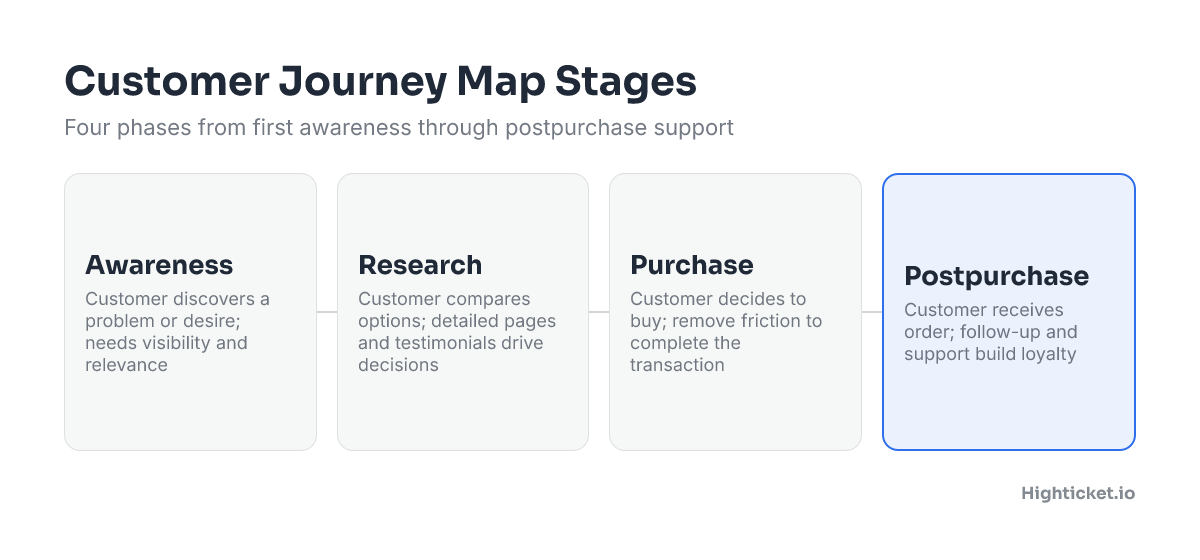
Stores that treat every visitor the same way tend to see weak conversion rates even when their product is strong, because a visitor who just discovered the brand needs something entirely different from one who has spent days comparing options. A customer journey map makes that difference visible so you can act on it. Understanding these stages also connects directly to how you optimize your sales funnel for each phase.
Awareness
This is the moment a potential customer first realizes they have a problem or desire. At this point they are not ready to buy and are typically still working out what they are looking for.
Your job at this stage is visibility and relevance. A person searching "best home gym equipment" is not comparing checkout options yet. They need to find you, feel that you understand their situation, and trust that you are worth a second look. Content, SEO, and targeted ads all serve this stage.
Research
Now the customer is actively comparing. They are reading product descriptions, checking reviews, and weighing options against each other. This is where most high-ticket purchases are genuinely won or lost.
Detailed product pages, real customer testimonials, and clear supplier credibility signals do the heavy lifting here. A buyer considering a premium purchase will spend considerable time in the research stage. If your store does not answer their questions thoroughly, they will find one that does.
Purchase
The customer has made their decision. Now friction is your enemy. A complicated checkout, an unclear return policy, or a slow page load can unravel a buying decision that took weeks to build.
Your goal is to remove every possible obstacle between intent and transaction.
Postpurchase
This is where most stores go quiet, and that is a costly mistake. The postpurchase experience shapes whether a customer leaves a review, returns for another order, or refers someone else to your store.
Follow-up communication, order transparency, and proactive support turn a one-time transaction into a long-term relationship. In high-ticket e-commerce, where a single repeat customer can represent significant revenue, that relationship is worth protecting.
Benefits of Using Customer Journey Maps
Once you understand the stages in a sales funnel, the next question is what you actually gain by mapping them. The answer is more concrete than most people expect.
Spotting the Gaps That Cost You Sales
The most immediate benefit is visibility. IBM notes that businesses use customer journey maps to identify areas for improvement, optimize processes, and create seamless customer-centric experiences. In plain terms, the map shows you exactly where customers hit friction, get confused, or drop off before they buy.
For a high-ticket store, those gaps are expensive. If a customer researching a premium product lands on a page with no reviews, no clear warranty information, and no way to ask a question, they leave. The map makes that invisible problem visible before it costs you another sale.
Reducing Churn After the Sale
Most store owners focus all their attention on getting the first sale. The journey map forces you to look further. IBM notes that identifying pain points in the postpurchase or support phase allows businesses to catch problems that might otherwise lead to customer churn.
In high-ticket e-commerce, postpurchase experience drives referrals, repeat business, and reviews. A customer who made a large purchase and received zero follow-up is unlikely to return. Mapping the support and delivery phase reveals where your process breaks down before it becomes a pattern.
Aligning Your Team Around the Customer
Journey maps also solve an internal problem: misalignment. When your marketing, fulfillment, and customer service processes operate in separate silos, the customer experience suffers. IBM describes how these visual representations give teams a unified view of complex interactions, which means marketing, operations, and support can all see the same picture of what the customer experiences at each stage.
That matters especially when you are scaling. A shared journey map keeps everyone focused on the same outcome, a customer who buys, receives their order smoothly, and tells others about the experience. The map is not a document you file away. It is a working tool you return to every time something in your store stops performing.
Creating Effective Customer Journey Maps
Building a customer journey map sounds straightforward until you sit down to do it. The real challenge is discipline, because most maps end up reflecting internal assumptions rather than real customer behavior. Keeping that discipline requires the same mindset that separates a well-structured store from a scattershot one, whether you are selling physical goods or researching print on demand products to understand how other models approach the customer relationship.
Here is how to build one that actually reflects how your customers act.
Step 1, Define Your Persona and Scope
Start with one customer segment and one goal. Mapping every type of buyer in a single session produces a diagram too broad to act on.
Choose the persona most relevant to your current growth priority. For a high-ticket store, that might be a first-time buyer considering a significant premium purchase. Define their starting point (a Google search, a YouTube video, a referral) and their end point (a completed purchase, or a refund request if you are mapping retention). Narrow scope produces maps you can actually use.
Step 2, Collect Real Customer Data
Do not guess at what customers think or feel at each stage. Collect it.
Practical data sources include,
- Customer support tickets and chat logs
- Postpurchase email surveys
- Session replays showing where visitors hesitate or exit
- Google Analytics paths showing drop-off points by page
- Reviews and testimonials noting what convinced buyers to commit
Look for patterns across sources, not individual anecdotes. If twelve customers mention needing to verify your return policy before purchasing, that is a touchpoint requiring attention on your map.
Step 3, List Every Touchpoint
A touchpoint is any moment a potential customer interacts with your brand. List all of them for your chosen persona, from first ad impression through to post-delivery follow-up email.
Common touchpoints for a high-ticket store include Google Shopping ads, product detail pages, live chat conversations, shipping confirmation emails, and review request messages. For each touchpoint, note what the customer is thinking, feeling, and doing. "Feels uncertain about delivery time" is more useful than "feels worried."
Step 4, Visualize and Validate
Place your touchpoints on a timeline. Mark the stages from awareness through postpurchase. Flag the moments where customer emotion drops or where your data shows friction.
Format matters less than clarity. A simple table with columns for stage, touchpoint, customer emotion, and your current response is enough to start. Once you have a draft, share it with your support team or a sample of real customers to verify it reflects their actual experience.
A map built on real data and reviewed by real people becomes a working document, not a decoration.
Customer Journey Maps vs. Marketing Funnels
These two tools get used interchangeably, and that confusion costs stores real money. They are related but serve different purposes, and mixing them up creates gaps in your strategy.
What a Marketing Funnel Measures
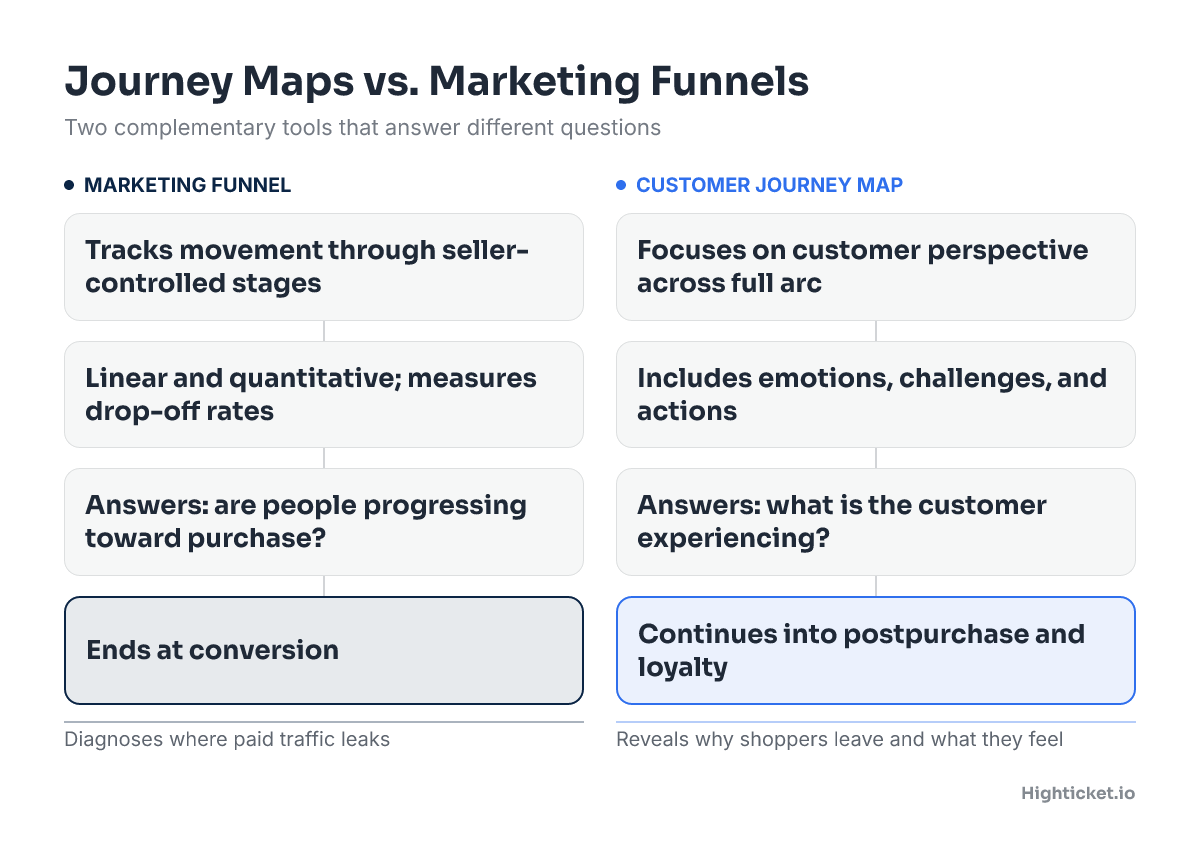
A marketing funnel tracks movement through stages your business controls, awareness, consideration, and conversion. It is linear and quantitative, answering one question, are people progressing toward a purchase?
Funnels are built from your perspective as a seller. They measure drop-off rates, conversion percentages, and cost per acquisition. That makes them useful for diagnosing where paid traffic is leaking, but they tell you almost nothing about why a shopper left or what they were feeling when they did.
What a Customer Journey Map Adds
A customer journey map focuses on the customer's perspective across the full arc of their experience, including stages that happen before they land on your store and long after they complete a purchase.
Where a funnel ends at conversion, a journey map continues into onboarding, postpurchase support, and loyalty. As Adobe notes, a customer journey map is customer-centric, highlighting the customer's emotions, challenges, and actions at each stage of interaction. Funnels compress behavior into metrics. Journey maps expand behavior into context.
Which One to Use When
Use both, but for different decisions.
- Reach for your marketing funnel when diagnosing a specific performance drop, such as low add-to-cart rates or high checkout abandonment.
- Reach for your customer journey map when designing a new touchpoint, writing product page copy, or figuring out why qualified traffic is not converting despite healthy funnel numbers.
In a high-ticket store, customers rarely convert after a single visit. The journey map helps you plan the content, follow-up sequences, and trust signals that need to exist across multiple sessions before a buyer is ready to act. The funnel tells you whether that plan is working.
Using Journey Maps to Sharpen Your Marketing
Knowing where your customer sits in their decision process changes what you say to them and when. That shift from broadcasting to meeting people where they are is where journey maps pay off most directly.
IBM's research puts it plainly: by better understanding the customer journey, businesses can create targeted campaigns that meet customers where they are, increasing engagement and conversion from marketing efforts.
In practical terms, your ad creative, email copy, and landing page messaging all change depending on which stage a visitor occupies. A shopper in the awareness stage needs educational content that builds trust. A shopper comparing options needs specific proof, reviews, product specs, and clear differentiators. A shopper ready to buy needs a frictionless path to checkout.
Matching Messages to Moments
The biggest marketing waste comes from sending the wrong message at the wrong moment. Running a hard sales pitch to someone still researching product categories burns your ad budget and trains your audience to tune you out.
Map your customer stages first, then assign one primary message to each. Awareness campaigns should lead with value and education, while consideration-stage messaging should centre on proof and comparison so the shopper can see clearly why your store fits their needs. Once a buyer reaches the decision stage, the message should focus on a clear, low-friction call to action that removes the last remaining obstacles.
Running all three message types simultaneously to segmented audiences is how you move people through the journey without losing them.
Turning Map Insights into Campaign Decisions
Journey maps give your marketing a shared reference point. Instead of guessing which ad to run, you match each campaign to a specific stage and measure whether it moves people forward.
Track stage-specific metrics, content engagement at awareness, time on site and return visits at consideration, cart completion rate at decision. When a metric stalls, you know exactly where the journey breaks and what to fix.
That precision is what separates stores that scale from stores that stay stuck.
We do not guarantee any income results. Results vary based on effort, market conditions, and personal skills.