


There are many ways to make extra money outside a regular paycheck, but the options can feel overwhelming. Freelancing, selling online, building an e-commerce store, tutoring and creating content all compete for attention, and not every path suits every person.
This guide maps the most practical options to what they actually require in time, skill and effort. That way you can match an approach to your real situation rather than chasing whatever sounds most appealing.
Key takeaways
- Freelancing is one of the most accessible starting points because it turns skills you already have into income with very low setup costs.
- Online sales platforms lower the barrier to selling physical or digital products, but margins and competition vary widely by platform and product type.
- High-ticket e-commerce needs far fewer sales to reach meaningful margin, but each sale is harder to win and brands must approve you as a reseller.
- Technology has removed most of the old infrastructure barriers, so a side business can realistically run from a laptop.
- The right option depends more on your available hours and existing skills than on which model sounds most lucrative in theory.
The verdict: which way to make extra money fits best?
There is no single best way to make extra money, but there are better and worse fits depending on what you bring and how much time you can commit. The short version is below, and the rest of this guide explains the reasoning.
Quick income with almost no upfront cost
Freelancing and tutoring work well for people who have a marketable skill and want income quickly. Both need little more than a profile on the right platform.
Selling products you make or source
Selling on platforms like Etsy suits people who make or source physical products and can manage fulfillment. Digital products suit people willing to put in heavy upfront effort for ongoing sales.
A more scalable ceiling, with more hurdles
High-ticket dropshipping, the model taught by High Ticket, has a higher ceiling because each sale carries a far larger margin. It also has bigger obstacles than the other options here:
- Brands must approve you as a reseller.
- Customers need strong reasons to trust a store with a large purchase.
- Ad spend can run ahead of revenue while you test.
Results take months of consistent effort and are not guaranteed.
Salesforce notes that side hustles provide extra income and create a financial safety net. The right choice is the one you will actually follow through on, given your schedule and starting point.
How each extra income option was evaluated

Each option in this guide was assessed on the same four measures. Together they determine whether a side hustle is realistic for someone already working full-time who cannot afford to sink hundreds of dollars into an untested idea.
Time commitment
This separates hustles that fit into a part-time schedule from those that demand sustained attention before they pay off.
Required skills
This separates options that need transferable professional abilities from those almost anyone can start with basic instruction.
Earning potential
This reflects what an average beginner can realistically achieve, rather than what an exceptional outlier reports.
Setup cost
This covers platforms, tools, advertising and any course or training investment needed to get started.
Results from any of these options are not guaranteed and depend on individual effort, market conditions and personal skills.
Comparison table: 7 ways to make extra money
The table below summarizes each option against those four measures. Figures come from the sources linked in each section, and “varies” means no reliable single range exists.
Why the high-ticket row needs a closer look
High Ticket’s FAQ puts the average margin at 25% to 30% on products costing $3,000 or more. It compares that with typical low-ticket margins of 10% to 15% on $20 to $50 products. On paper, the gap in sales volume is large:
These are gross figures. They come before advertising, payment processing fees, refunds and other operating costs. High Ticket’s own income disclaimer policy notes that some students generate revenue but lose money after expenses.
The table also hides the harder part. Persuading a stranger to spend $4,000 with a new store takes far more trust than a $35 purchase does. Each high-ticket sale usually takes more ad spend and more customer service to win.
Freelancing as a side hustle
Scramble ranks freelancing among the most flexible and scalable ways to earn extra, especially for anyone with a professional skill. Writers, designers, marketers, developers and project managers all have abilities that transfer directly into paid work.
How to get started
The practical path is straightforward. Salesforce points to Upwork, Freelancer and Fiverr as places to find clients. All three let you create a profile, set your rates and start applying to projects within a day.
Early work may come at lower rates while you build reviews. As a realistic benchmark, Scramble describes a full-time teacher who writes blog articles on weekends and earns an extra $300 to $500 a month through Upwork.
The hourly ceiling
The honest limitation is that freelancing scales with your time. You are trading hours for dollars, and a week that already contains a job only has so many billable hours left.
For people who eventually want to replace their salary rather than supplement it, freelancing works well as a starting point. Over time, it may need to be combined with a more scalable model.
The lowest-risk entry point
Start with one project in your existing area of expertise. Charge a fair rate for your level, deliver well, collect a review and repeat. Good reviews compound on freelance platforms, but they take a few months to build real momentum.
Where freelancing fits in the gig economy
Freelancing sits within the wider gig economy of independent, short-term work. Scramble credits digital platforms, the gig economy and remote work with putting extra income within reach of almost anyone. In-demand skills range from writing and translation to web design, software development and virtual assistance.
Selling products online to make extra money
Scramble lists Etsy, eBay, Shopify and Amazon as platforms for selling handmade crafts, vintage items and digital goods. The barrier to listing a product is genuinely low. That is both the appeal and the challenge, because competition is high in most categories.
Etsy for makers and designers
Etsy suits makers and designers whose products have a handmade or unique character. Salesforce recommends showing the product in action and writing SEO-friendly descriptions that highlight key benefits. A well-presented product in a low-competition niche can attract steady search traffic, while a poorly presented one will sit unseen regardless of quality.
Amazon and the inventory problem
Amazon is a different environment. Selling through Amazon FBA (Fulfillment by Amazon) usually means buying inventory before you know whether it will sell. High Ticket’s product sourcing guide warns that success on Amazon demands sharp pricing and strong customer service.
Dropshipping as the inventory-free alternative
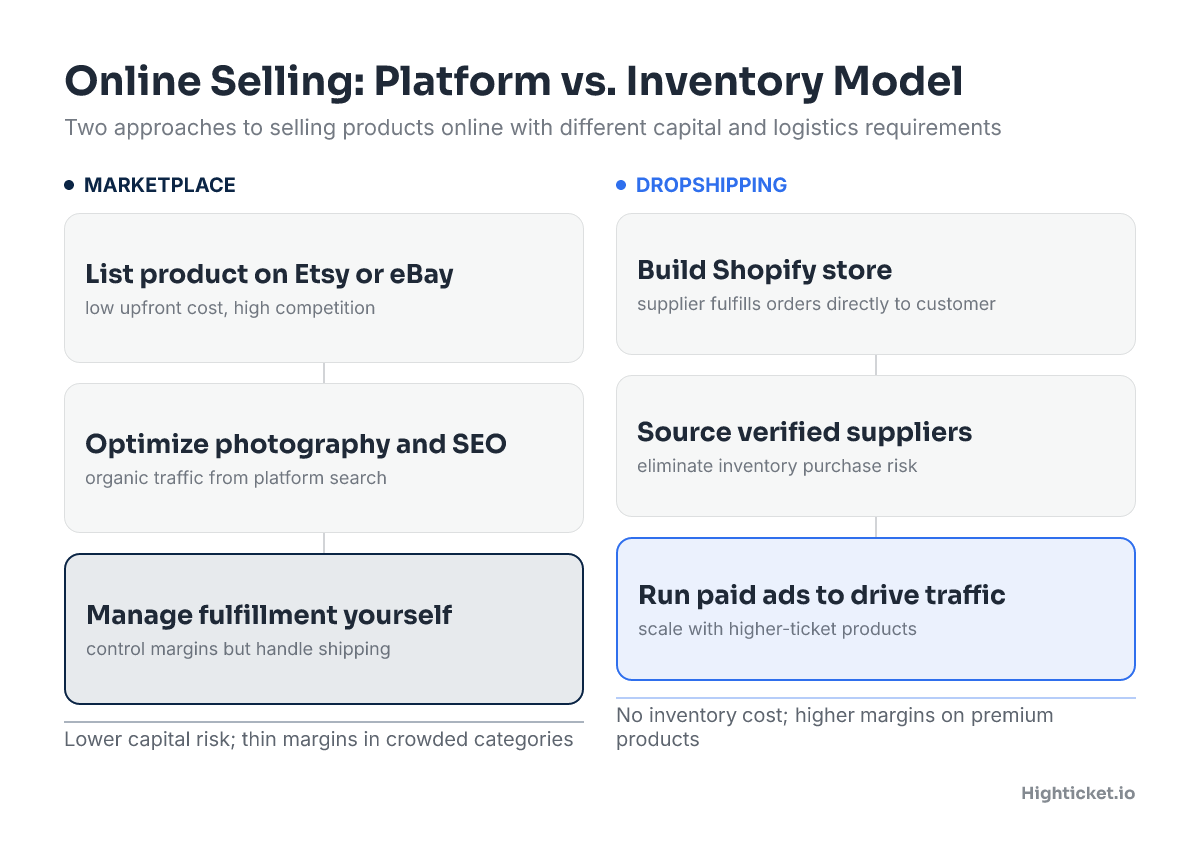
For people who want to avoid holding stock entirely, dropshipping through a Shopify store is the natural alternative. If you want to understand how to make money dropshipping, the core principle is simple. A supplier ships orders directly to your customer, so you never buy inventory before a sale.
Margin is the variable that matters most
The key variable across all online selling is margin. Salesforce advises making sure products leave enough profit to be worth your time after advertising costs, and notes that high-end items offer better margins.
Low-ticket products in crowded categories produce thin margins that erode quickly under ad spend. Higher-priced products from established brands carry larger margins per sale. They also cost more to sell, because each customer takes more convincing.
Technology and side hustles
Salesforce puts it plainly: technology has taken down many of the old barriers. You no longer need expensive equipment, a physical location or a technical team to run a side business. The changes show up in three places.
Tools that replace admin work
For freelancers, Scramble suggests tools like Trello, Notion and Google Sheets to track work, deadlines, income and clients in one place. For e-commerce operators, Shopify bundles store creation, payment processing and basic analytics into a single platform that beginners can learn quickly.
Faster supplier research
The bigger shift is in supplier discovery. Finding legitimate suppliers willing to work with small operators used to take extensive cold outreach with a low success rate.
High Ticket’s Supplier HQ platform combines a supplier database, a search demand tool and a CRM for managing outreach. It speeds up research, but you still confirm pricing and terms directly with each supplier, and each brand still decides whether to approve you. This matters most for dropshipping and reselling, where supplier quality is the foundation of the whole model.
Content creation without burnout
For content creators, AI writing assistants, video editing tools and scheduling platforms make it feasible to publish consistently alongside a full-time job. Salesforce notes that tasks which used to take days now take minutes, using tools that were not available even five years ago.
The constraint has moved
The technology now exists to run a real side business with far less administrative work. The constraint is no longer access to tools. It is deciding which model to commit to and following through.
Which side hustle fits your situation
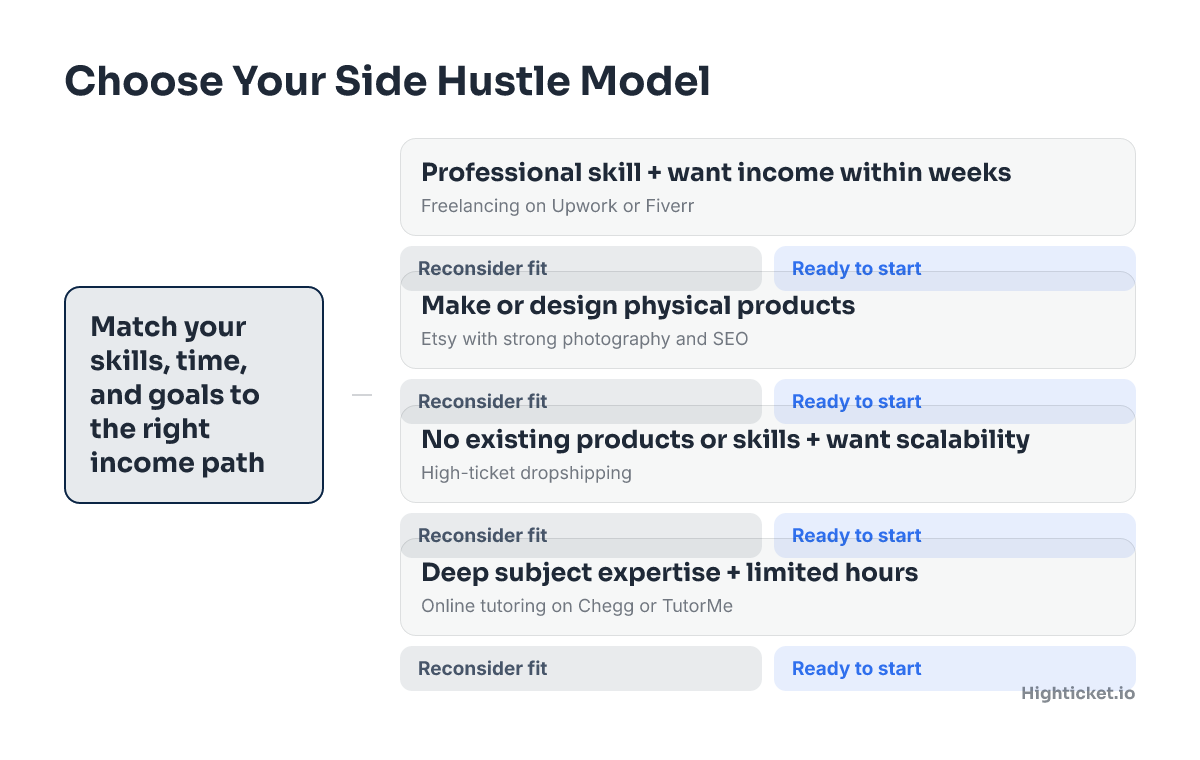
The best match depends on what you already have: a skill, a product, subject knowledge or simply time. Find the description closest to your situation below.
You have a professional skill and want income within weeks
Start with freelancing. Build a profile on Upwork or Fiverr, apply to five relevant projects in your first week, and price slightly below your target rate to win initial reviews. Adjust upward once you have a track record.
You make or design physical products
Etsy is the natural first platform. Invest time in photography and listing SEO before spending anything on advertising, and prove there is organic demand before scaling.
You want something scalable and can commit months of work
High-ticket dropshipping is worth considering if you can commit time and money before seeing a return. High Ticket’s FAQ recommends:
- at least one to two hours a day for a minimum of three months;
- $500 to $1,000 to set up the store;
- around $500 for ads, on top of the cost of training.
The FAQ says no e-commerce experience is needed. The work itself is still demanding.
The biggest hurdle is supplier approval. Under the model, your business has to become an authorized reseller of each brand, and established brands choose who sells their products. High Ticket’s About page states that training cannot guarantee supplier approval, customers or financial results.
Advertising carries real risk too. The income disclaimer policy warns that ad costs can exceed revenue, particularly while testing. It also reports that most students who answered High Ticket’s survey had not yet launched a store, and most had no sales.
The High Ticket program covers the model across six months of structured training. It includes product research, supplier outreach, store setup and customer acquisition. Results are not guaranteed and depend on individual effort, market conditions and personal skills.
You have deep knowledge in a subject
Online tutoring is the fastest path to paid work with the lowest setup cost. Scramble names Preply and Cambly among the popular platforms and puts typical rates at $15 to $50 or more an hour. Tutoring does not scale beyond your available hours, but as a near-term supplement it is hard to beat on simplicity.
You have time to invest upfront and want income that is not tied to your hours
Digital products such as courses, templates, ebooks and design assets need significant effort before the first sale. Once the product and sales channel are established, they can keep selling. Salesforce notes that service-based and digital side hustles tend to be the most sustainable.
Pairing digital products with a YouTube channel or email list tends to build momentum as the audience grows. Timelines vary considerably depending on the niche and how consistently you publish.
How to stick with one side hustle long enough to see results
Most people who succeed with a side hustle pick one model, commit to it for at least six months and get good at it before diversifying. Jumping between options when results take time is the most common reason people quit before the effort pays off.
Set short-term goals
Scramble recommends setting short-term goals and celebrating small wins to stay motivated when progress feels slow. Time-blocking specific hours for your side hustle also helps it coexist with a full-time job.
Take the next step on the store route
If high-ticket e-commerce fits your goals, start by reviewing how the High Ticket program is structured. Then watch the student success interviews to hear what building a store actually involves before you commit.
Frequently asked questions
What is the fastest way to make extra money?
Freelancing and online tutoring are usually the fastest, because you can set up a profile and start applying for work within a day. Both rely on skills you already have, so there is little to learn before your first payment. The trade-off is that income stops when you stop working.
How much can you realistically make from a side hustle?
It depends on the method, the hours you put in and your skill level. Tutoring typically pays $15 to $50 or more an hour, and freelancers working weekends can earn a few hundred dollars a month to start. Higher-margin models like high-ticket e-commerce earn more per sale but carry higher costs and take longer to set up.
Do you need experience to start high-ticket dropshipping?
High Ticket’s FAQ states that e-commerce and advertising experience are not required. The model still involves winning approval from selective brands, building a store customers trust with large purchases, and managing ad spend. Most beginners need several months of steady work, and income is not guaranteed.
How much money do you need to start a high-ticket store?
High Ticket’s FAQ suggests $500 to $1,000 to set up the store, plus around $500 for ads, on top of training costs. Because brands ship directly to customers, you never buy inventory upfront. Advertising is the variable cost to watch, because spend can exceed revenue while you test.
Can you make extra money without spending anything upfront?
Yes, though it is usually slower. Tutoring, freelancing and selling digital products need little or no upfront cost. Content creation can also start for free, but building an audience takes significant time before it earns.