


The skills of an entrepreneur determine whether a business survives past the first few months far more than any single idea or product choice. Most people starting out focus on finding the right niche, but execution is what separates those who build something real from those who stay stuck in research mode.
Brook Hiddink changed his entire approach after 13 failed stores. When his skills around supplier relationships, traffic acquisition, and business positioning caught up with his ambition, the revenue followed.
Key takeaways
- Entrepreneurial skills are learnable through real business decisions, not prior expertise.
- Leadership, adaptability, financial literacy, communication, and resilience each show up in specific, practical ways inside an e-commerce store.
- Decision-making under uncertainty and resource allocation are among the most consequential skills in the early stage of any venture.
- Digital literacy, adaptive problem-solving, and systems thinking are increasingly important for modern operators.
- Structured programs that combine instruction with live operational feedback accelerate skill development faster than self-study alone.
Core Entrepreneurial Skills for Success
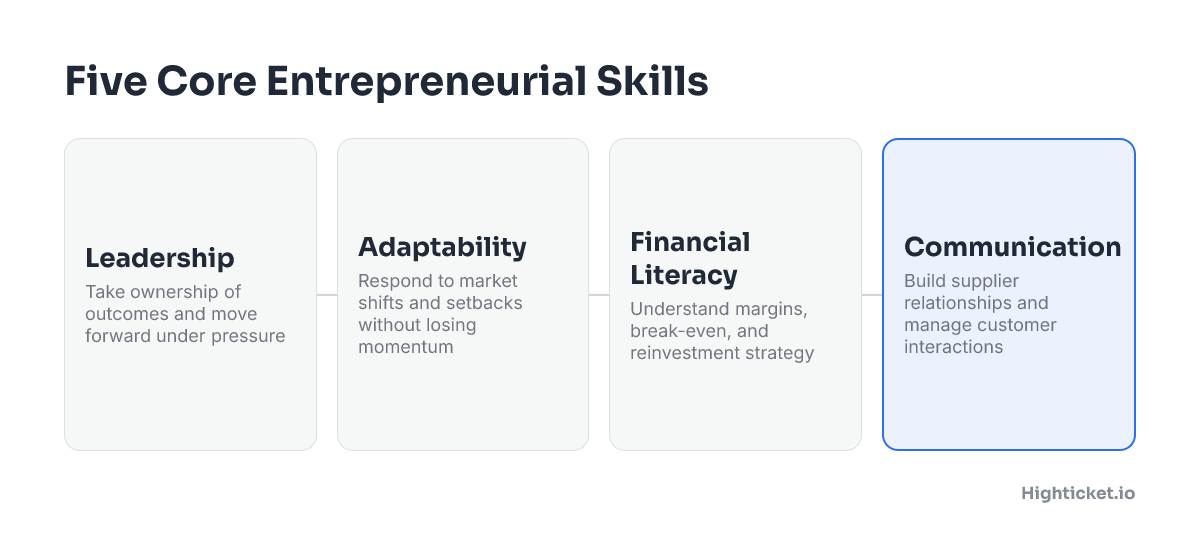
Building a profitable online store requires more than picking the right products. The decisions you make every day, about suppliers, ad spend, customer communication, and business structure, draw on a set of skills that determine whether your store compounds or stalls. Goodwin University identifies 10 foundational skills needed to succeed as an entrepreneur, and the overlap with what high-ticket e-commerce actually demands is direct and practical.
Leadership
Leadership in an e-commerce context means taking ownership of outcomes rather than waiting for conditions to improve. When a Google Shopping campaign underperforms or a supplier goes quiet, you make a decision and move forward. Students who treat their store like a real business from day one, managing timelines, setting priorities, and holding themselves accountable, tend to reach their first sale faster than those who stay in preparation mode indefinitely.
Adaptability
Markets shift, supplier terms change, and Google Merchant Center policies update without warning. Adaptability means you respond to those changes without losing momentum.
In practice, this looks like pivoting your niche research when search demand data signals a saturated category, or adjusting your ad bids when cost-per-click rises in a competitive segment. The operators who scale past five figures a month are almost always the ones who treat setbacks as information rather than obstacles.
Financial Literacy
Financial literacy, at its most practical, means understanding what your numbers actually tell you about the health of your store. In high-ticket dropshipping, profit margins typically run between 25% and 30%, which means a single premium sale can generate substantial profit from a single transaction.
Knowing how to read those margins against your ad spend, calculate your break-even point, and reinvest strategically is what separates operators who grow from those who generate revenue without ever building a real business.
Communication
Supplier outreach, negotiation, and ongoing account management all depend on your ability to communicate clearly and professionally. This is an area where many beginners underestimate the effort involved. Securing an authorized reseller agreement with an established brand takes real conversations, consistent follow-up, and genuine relationship building across multiple touchpoints. The same applies to customer service, which directly affects your store's reputation and repeat purchase rate.
Resilience
The path from first store to consistent monthly revenue includes periods where nothing seems to be working. Resilience is what keeps you iterating rather than quitting.
Brook Hiddink's 13 failed stores before finding a model that worked is the clearest example of what this looks like in practice. The skill shows up in continuing to test, learn, and refine when early results are discouraging.
Whether you are starting completely from scratch or carrying experience from another field, these skills develop through the act of running a real store, making real decisions, and learning from what the results tell you. Results depend on individual effort, market conditions, and personal skills, and we do not guarantee any income results.
Practical Applications of Entrepreneurial Skills
Knowing a skill in theory and deploying it under real business pressure are two different things. As Envolve notes in its guide to the 15 skills every entrepreneur needs to master, most entrepreneurs and motivated professionals understand the importance of investing in themselves and building valuable skills over time, but the gap between knowing and doing is where most people stall.
The practical equivalent is deciding where to spend your early days as an operator, on niche research, supplier outreach, or Google Shopping setup. Each choice tests a different skill under real conditions, and the results tell you more about your capabilities than any assessment could.
Decision-Making Under Uncertainty
Every high-ticket store owner faces a version of the same challenge that strategic thinkers encounter in a game of bridge: you have incomplete information, limited resources, and the cost of a wrong move compounds over time. Acting on the best available information, rather than waiting for certainty that never arrives, is what allows operators to move forward when conditions are still unclear.
John Devolites, a business educator at the UTC edu business school, has framed this as one of the most transferable competencies a builder can develop. The Bolton entrepreneurship research tradition reinforces the same point: structured decision-making under constraint separates operators who scale from those who stay stuck at their first plateau.
Students who apply this inside the High Ticket program tend to move faster through the niche selection phase because they use search demand data and margin benchmarks to make a call, rather than endlessly second-guessing their choice.
Resource Allocation in the Early Stage

One of the clearest practical tests of entrepreneurial skill is how a new operator allocates limited resources across competing priorities. The cdn tetr framework from edu business research at utc edu identifies resource allocation as a foundational success driver, particularly in the early months of a new venture.
Inside a high-ticket store, this plays out in specific ways.
- Ad budget timing. Committing Google Shopping spend before the product feed and Google Merchant Center account are properly configured wastes money that early-stage operators cannot recover easily.
- Supplier outreach sequencing. Contacting the highest-potential suppliers before your store looks credible tends to produce rejections that close doors permanently.
- Time distribution. Splitting attention equally across all tasks produces slow progress across all of them; experienced operators pick one bottleneck and clear it before moving to the next.
The students who reach their first sale fastest are almost always the ones who made a deliberate choice about where to focus their effort first, then held that focus long enough to see results. We do not guarantee any income results; individual outcomes depend on effort, market conditions, and personal skills. See the full disclaimer policy for details.
Emerging Skills for Modern Entrepreneurs
The entrepreneurial landscape has shifted considerably, particularly since COVID accelerated the move toward digital commerce and remote work. Buyers now research purchases online before ever speaking to a seller, algorithms reward businesses that communicate with precision, and the pace of change in any given market compresses the window for adaptation. The skills that help entrepreneurs thrive today address genuinely new demands that go beyond updated versions of traditional ones.
Researchers at Stanford GSB have explored what separates ordinary business builders from extraordinary ones, finding that the differentiating qualities tend to be cognitive and behavioral rather than purely technical.
The capacity to reframe a problem, something systems thinker Peter Checkland built into his structured learning cycles, matters as much as knowing which tools to use. Envolve's catalogue of 15 skills every entrepreneur needs to master reflects the same pattern, with an increasing weight placed on adaptive and digital capabilities.
Digital Literacy and Data Interpretation
Modern entrepreneurs need to read data well enough to make daily decisions with confidence. In high-ticket e-commerce, that means understanding which Google Shopping keywords are generating revenue versus which are draining ad budget, and adjusting bids before the losses compound. You do not need a data science background; you need enough literacy to spot patterns and act on them.
Adaptive Problem-Solving

The inventor Sakichi Toyoda popularized the practice of asking "why" repeatedly until a root cause surfaces, a discipline that translates directly into diagnosing why a store underperforms. Entrepreneurs with a strong entrepreneurial spirit apply this kind of structured curiosity rather than defaulting to surface-level fixes.
The mathematician David Hilbert described productive thinking as the ability to hold a well-formed question long enough to find a genuine answer, and that patience has real commercial value when you are troubleshooting a Google Merchant Center account or refining a supplier outreach sequence.
Systems Thinking and Process Design
Building a store that generates consistent revenue requires treating operations as a system rather than a collection of isolated tasks. When a supplier relationship, a product feed, and an ad campaign all interact, a change in one affects the others.
Entrepreneurs who develop this perspective catch problems earlier and scale more deliberately. This complements the five core skills covered in the section above, leadership, adaptability, financial literacy, communication, and resilience, and the combination is increasingly learnable through structured programs that pair instruction with live operational feedback.
Developing Your Entrepreneurial Skill Set
Knowing which skills matter is only half the equation. The other half is building them through real decisions, because most people who explore online business ideas 2025 discover gaps in their knowledge only after those gaps cost them time or money.
Junior Achievement of Dallas notes that the rising popularity of starting a business has elevated the dreams of millions, yet the qualities required to act on those dreams still need to be developed through intentional effort. That gap between aspiration and capability is exactly where structured learning earns its value. Goodwin University's framework of 10 essential entrepreneurial skills provides a useful benchmark for identifying where to invest first.
Formal Education Pathways
Formal credentials can sharpen the learning curve considerably for those who have the time and resources to pursue them. A BSBA management degree, for example, builds foundational knowledge in operations, finance, and organizational decision-making that transfers directly to running a scaling e-commerce business.
For those interested in the data side of growth, programs in business analytics and big data teach the analytical thinking behind interpreting ad performance, identifying high-demand products, and reading margin data at scale.
A master of accountancy sharpens financial literacy in ways that become increasingly important as revenue grows, particularly around tax obligations, cost of goods accounting, and cash flow management. Student magazine publications produced by business schools also serve as accessible entry points into current thinking on entrepreneurship, market research, and digital commerce strategy.
Self-Directed Learning and Structured Programs
Formal education has a long timeline. Many entrepreneurs building their first store need skills on a faster track, and structured online programs deliver exactly that kind of targeted, applied learning.
The most effective self-directed development combines a few specific inputs.
- Industry-specific training. Programs focused on a single model, such as high-ticket e-commerce, teach the precise skills the business requires rather than general business theory.
- Mentorship from active operators. Coaches who are currently running profitable stores bring guidance that reflects real market conditions. That practical currency matters more than theoretical frameworks drawn from a fixed curriculum.
- Hands-on practice. Skills like Google Ads management, supplier outreach, and Shopify store optimization develop fastest through doing, with feedback from someone who can identify mistakes early.
- Peer community access. Surrounding yourself with other builders at similar stages creates accountability and surfaces practical solutions that no course module anticipates.
The combination of structured input and real execution is what moves skill development from theoretical to operational.
Reading about entrepreneurial skills is useful. Acting on them is what separates people who stay curious from people who build real businesses.
The skills covered throughout this article, strategic thinking, financial literacy, resilience, communication, and adaptability, compound over time. You do not need to master all of them before you start. What matters is that you develop them in the context of real decisions, real customers, and real revenue, because that pressure accelerates learning faster than any course read in isolation.
The most consistent pattern among the students at Highticket.io is not that they arrived with business experience. Most came from completely different backgrounds, law, oil and gas, retail, corporate operations. What they had in common was a willingness to apply each skill inside a structured model rather than figure everything out independently.
Consider what that looks like in practice:
- Mindset. Students who treated early obstacles as data points rather than verdicts adjusted their approach faster and stayed in the game longer.
- Financial discipline. Managing ad spend, interpreting margin data, and reading supplier terms all become natural through repetition inside a real store.
- Communication. Outreach to suppliers, follow-up with customers, and negotiating wholesale agreements build this skill in weeks, because the feedback is immediate.
- Adaptability. Pivoting a product selection or adjusting a Google Shopping campaign based on performance data is a practical skill that grows with each iteration.
Collectively, students have generated over $70 million in revenue, and those results reflect consistent skill application across thousands of different individuals, markets, and product categories. Results depend on individual effort, market conditions, and personal skills. We do not guarantee any income results, see the full disclaimer policy for complete context.
The next step is straightforward: pick the model, commit to the process, and start building the skills that matter through real work.
Skills of an Entrepreneur: The Next Step
Reading about entrepreneurial skills is useful. Acting on them is what separates people who stay curious from people who build real businesses.
The skills covered throughout this article, strategic thinking, financial literacy, resilience, communication, and adaptability, compound over time. You do not need to master all of them before you start. What matters is that you develop them in the context of real decisions, real customers, and real revenue, because that pressure accelerates learning faster than any course read in isolation.
The most consistent pattern among High Ticket’s 12,000+ enrolled students is not that they arrived with business experience. Most came from completely different backgrounds, law, oil and gas, retail, corporate operations. What they had in common was a willingness to apply each skill inside a structured model rather than figure everything out independently.
Consider what that looks like in practice:
- Mindset. Students who treated early obstacles as data points rather than verdicts adjusted their approach faster and stayed in the game longer.
- Financial discipline. Managing ad spend, interpreting margin data, and reading supplier terms all become natural through repetition inside a real store.
- Communication. Outreach to suppliers, follow-up with customers, and negotiating wholesale agreements build this skill in weeks, because the feedback is immediate.
- Adaptability. Pivoting a product selection or adjusting a Google Shopping campaign based on performance data is a practical skill that grows with each iteration.
Collectively, students have generated over $70 million in revenue, and those results reflect consistent skill application across thousands of different individuals, markets, and product categories. Results depend on individual effort, market conditions, and personal skills. We do not guarantee any income results, see the full disclaimer policy for complete context.
The next step is straightforward, pick the model, commit to the process, and start building the skills that matter through real work.