


The market research methods and techniques you choose in your first few weeks determine whether you spend months chasing the wrong products or enter a niche with verifiable, year-round demand. Market research is the process of gathering and analyzing information about your target customers, competitors, and the landscape your business will operate in.
Done well, it tells you what people actually want to buy, what they are willing to pay, and where gaps exist that your store can fill profitably. This article covers the main quantitative and qualitative approaches, how to choose the right tools, and how AI fits into a modern research process.
Key Takeaways
- Quantitative methods such as surveys and search demand analysis give you measurable, comparable data on whether a market exists.
- Qualitative methods such as interviews and focus groups reveal the motivations and hesitations that numbers alone cannot explain.
- Match your research tools to the size and stage of the decision, not the other way around.
- AI compresses research time at the front end but works best on top of solid research fundamentals.
- Combining methods in sequence, broad validation first and then deeper investigation, produces sharper decisions than relying on any single source.
Why Market Research Drives Better Business Decisions
Every strong business decision traces back to reliable information. When you understand your market before you launch, you stop guessing and start executing with confidence.
This matters especially in high-ticket e-commerce, where each sale carries a meaningful profit margin. Choosing the wrong niche, pricing incorrectly, or targeting the wrong buyer means burning time and ad budget on a store that was never going to work.
Market research changes that equation. It gives you a factual foundation for three decisions that determine whether a store succeeds or stalls. Which niche has consistent, year-round search demand? Which supplier relationships are worth pursuing? Which customer problems your store is actually solving?
Understanding Market Needs Before You Build
The most common mistake beginners make is building the store first and researching the customer second. That sequence guarantees frustration.
Start by identifying who your ideal buyer is, what they are searching for, and what motivates them to spend a significant sum on a product online. A buyer making a large considered purchase thinks differently than someone making a low-cost impulse buy. Understanding that difference separates a store that converts from one that collects traffic but no revenue.
When you know your market's real needs, every downstream decision becomes sharper. From product selection to ad targeting to competitor analysis tools, validated market knowledge is what makes those choices land.
Quantitative Research Techniques for Gathering Actionable Data
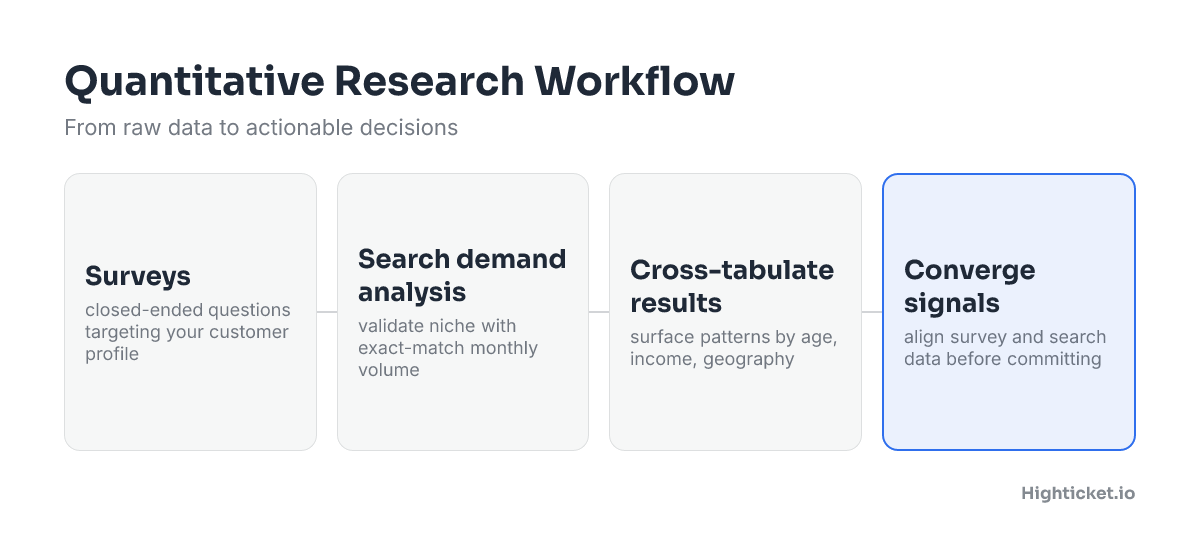
Quantitative research trades intuition for numbers. Where a gut feeling tells you a niche "feels right," structured data tells you whether enough buyers actually exist to build a business around it. That distinction matters when you are about to invest real time and money into a high-ticket e-commerce store.
Surveys and Structured Questionnaires
Surveys are the most direct quantitative tool available to a new store owner. You write specific, closed-ended questions, collect responses from a defined group, and end up with data you can sort, count, and compare.
The key is specificity. A vague question like "Would you buy a premium outdoor sofa?" tells you very little. A sharper question is, "How much would you expect to pay for a weather-resistant outdoor sofa set from a brand you already recognized?" That answer gives you pricing signal, brand preference signal, and purchase intent in a single data point.
Sample Junction outlines practical data collection techniques for quantitative research, including how to connect with panels of respondents who match specific demographic profiles. For a store owner validating a niche, that kind of targeted access means reaching actual buyers rather than a general population.
When building a survey, keep these principles in mind:
- Use closed-ended questions with defined answer options so responses are measurable
- Keep the survey under ten questions to protect completion rates
- Target respondents who match your intended customer profile
- Cross-tabulate results by age, income bracket, or geography to surface patterns within the data
Analyzing Search Demand Data

Search volume is one of the most reliable quantitative signals available without running a single ad. When someone types a product query into Google, they are expressing real purchase intent. Aggregate those queries across millions of searches and you get a clear picture of whether genuine demand exists for a category.
A core product term with measurable monthly search volume confirms there is an audience actively looking to buy. A niche with negligible search volume does not support a viable store, regardless of how strong the margins look on paper.
The practical check is straightforward. Look at exact-match monthly search volume for your primary product terms. Then examine the commercial-intent variations, brand comparisons, "best" queries, and category-level terms that signal a buyer close to a purchase decision rather than someone doing early-stage research.
Turning Data Into Decisions
Collecting numbers is only useful if you act on them. The goal of quantitative research is not a spreadsheet full of statistics. It is a clear go or no-go signal on the decisions in front of you.
When your survey data and search demand data point in the same direction, that convergence is meaningful. When they contradict each other, that tension is worth investigating before you commit. Building a sustainable online business on top of validated data gives you a structural advantage from day one.
Qualitative Research Methods for Understanding Consumer Behavior
Quantitative data shows you what is happening in a market, but qualitative research explains the underlying reasons. When a potential customer abandons a product page or ignores an ad, a survey score cannot explain the decision. A conversation can. That is the core value of qualitative methods: they surface the motivations, hesitations, and mental frameworks that sit beneath the data.
SAGE Publications offers a comprehensive guide covering the full range of approaches researchers use to decode consumer behavior. The foundational insight is consistent: qualitative methods capture consumer meaning, not just consumer action.
In-Depth Interviews
A one-on-one interview gives you direct access to how a specific person thinks about a problem, product, or purchase decision. You can follow a thread when an answer surprises you, which a multiple-choice survey never allows.
For e-commerce, this matters practically. Ask a prospective customer why they hesitated before making a high-value purchase online and you might discover they wanted clearer warranty information, a visible phone number, or greater brand recognition. Each answer points to a concrete change you can make to your store.
As Canadian Viewpoint notes, effective in-depth interviewing requires real skill, spending 90 minutes with a participant on an unfamiliar product and walking away with genuinely useful insight is not something every approach can replicate. Run five to ten interviews before drawing conclusions, and look for patterns across responses rather than treating any single answer as definitive.
Focus Groups
Focus groups bring a small number of participants together to discuss a topic, product, or concept. The group dynamic is the point. Participants react to each other's comments, surfacing opinions and objections that a solo interview might never reach.
The tradeoff is that dominant voices can skew the conversation. A skilled moderator keeps participation balanced and probes beneath surface-level agreement to find real disagreement. In practice, keeping groups to six to eight participants and preparing a tight discussion guide with three to five core questions helps maintain focus and gives you comparable output across sessions.
For niche research in high-ticket e-commerce, focus groups work well when you are evaluating messaging angles or comparing two positioning approaches before committing ad spend. If you cannot recruit a full group, even a structured conversation with three to four potential buyers can surface the objections and language patterns worth knowing before you write a single product description.
Why Qualitative Research Belongs in Your Process
Qualitative methods are not a replacement for data. They are the tool you use when the data raises a question that more data cannot answer. Use interviews and focus groups to sharpen your understanding of consumer motivations, then let that understanding inform how you position your store, write your product pages, and select the niches worth pursuing.
Choosing the Right Market Research Tools
Not every tool fits every stage of your business. The decision is simpler than it looks: which tool gives you the answer you need right now, at a cost that matches where you are in the journey?
Shopify's overview of market research tools is a useful starting point for exploring your options. Use the four criteria below to filter quickly.
Total Cost Relative to Decision Size
Match your research spend to the size of the decision it is informing. If you are still validating a niche, free and low-cost tools cover what you need. If you are scaling an established store and optimizing ad spend across multiple product lines, a more capable platform earns its price. Spending on research software before your store has made its first sale is a mismatch worth avoiding.
Depth of Data Versus Breadth of Coverage
Some tools give you a wide view across many industries, while others drill deep into a specific category, and for high-ticket e-commerce the depth-focused option is the more useful one.
You need margin data, supplier contact details, MAP enforcement status (MAP stands for minimum advertised price, the floor a brand sets so authorized resellers do not undercut each other), and real search demand for premium products. A general-purpose tool rarely surfaces that level of detail without significant manual work layered on top.
Learning Curve and Time to First Insight
A tool you cannot use confidently inside a week is a tool that stalls your momentum. Prioritize platforms with clear onboarding, solid support documentation, and a focused interface. If you are building your store while working a full-time job, your research time is limited. The faster a tool moves you from question to answer, the better.
Integration With Your Existing Workflow
The best research tool connects directly to the decisions you are already making, which niche to enter, which suppliers to contact, which products to list.
If you have to manually transfer data from a research platform into a spreadsheet and then into a separate CRM, you are adding friction at every step. Look for tools that consolidate those functions or at minimum export in a format your workflow can actually use.
Integrating AI Into Your Market Research Process
AI does not replace good judgment in market research. It compresses the time it takes to reach that judgment.
Where traditional approaches require you to manually sift through competitor listings, customer reviews, and search trend reports, AI tools can surface patterns across large volumes of data in minutes. That speed advantage matters most when you are trying to validate a niche before investing weeks of setup time.
Validating Ideas Before You Build
The most practical early-stage application of AI is idea validation. Rather than spending weeks running surveys or reading forums manually, AI tools can analyze demand signals and flag competitive saturation in a specific product category.
IdeaProof offers a free validation tool that illustrates how this works: you input a concept and the tool evaluates it against structured criteria rather than gut feeling. That kind of rapid feedback loop is useful when you are still deciding which niche to pursue.
Synthesizing Consumer Insight
AI also accelerates one of the most time-consuming parts of qualitative research, reading and making sense of customer sentiment at scale. Instead of manually combing through product reviews or forum threads, AI tools can categorize recurring complaints, identify frequently requested features, and highlight the language buyers actually use when describing a problem.
That last point is worth emphasizing. When you know the exact words your target customers use, you can mirror that language in your product listings, ad copy, and supplier outreach. It closes the gap between what you are selling and what the buyer feels understood by.
Where AI Fits in a Broader Research Process
AI works best as a high-ticket e-commerce program complement layered on top of the research fundamentals covered in earlier sections. It does not replace the need to verify demand with real data or build genuine supplier relationships. What it does is reduce friction at the front end, so you spend less time gathering raw information and more time acting on it.
Building Your Market Research Strategy
You have the tools and understand the individual methods. The last step is pulling everything together into an approach that serves your specific goals rather than just generating data for its own sake.
Align Your Research to a Specific Decision
Every piece of research you run should answer one concrete question. Are you validating a niche before you invest in a store? Trying to understand why visitors browse but do not buy? Deciding which product categories to expand into next?
Start there. Define the decision first, then choose the method that gets you the clearest answer.
Quantitative data reveals the scale of a problem, qualitative methods surface the root cause behind it, and AI accelerates the synthesis of both. These approaches work together rather than substituting for each other.
Combine Methods, Not Just Tools
Layering complementary approaches produces sharper results than relying on any single source. A survey reveals what customers say they want, competitor analysis reveals what the market already supplies, and search demand data reveals what buyers are actively hunting for right now. Together, those three inputs give you a far sharper picture than any single source could.
There is no need to run all three simultaneously. Work through them in sequence, starting broad and then narrowing your focus, validating assumptions before you build on them.
Keep the Strategy Proportional to the Stage
A brand-new store and a store generating consistent monthly revenue need different research intensities. Early on, focus on niche validation and supplier viability. As you scale, shift attention to conversion patterns and customer retention signals.
The goal is a business built on real market understanding, not guesswork. That means revisiting your research as conditions change, not treating it as a one-time box to tick.
If you are ready to apply structured market research to your product selection, the High Ticket free training walks you through how to identify a profitable niche, build real supplier relationships, and launch from scratch. Results vary based on effort, market conditions, and personal skills. We do not guarantee any income results. See the full disclaimer policy.